IR vs UV Drying in Printing Machines: Which One Should You Choose?
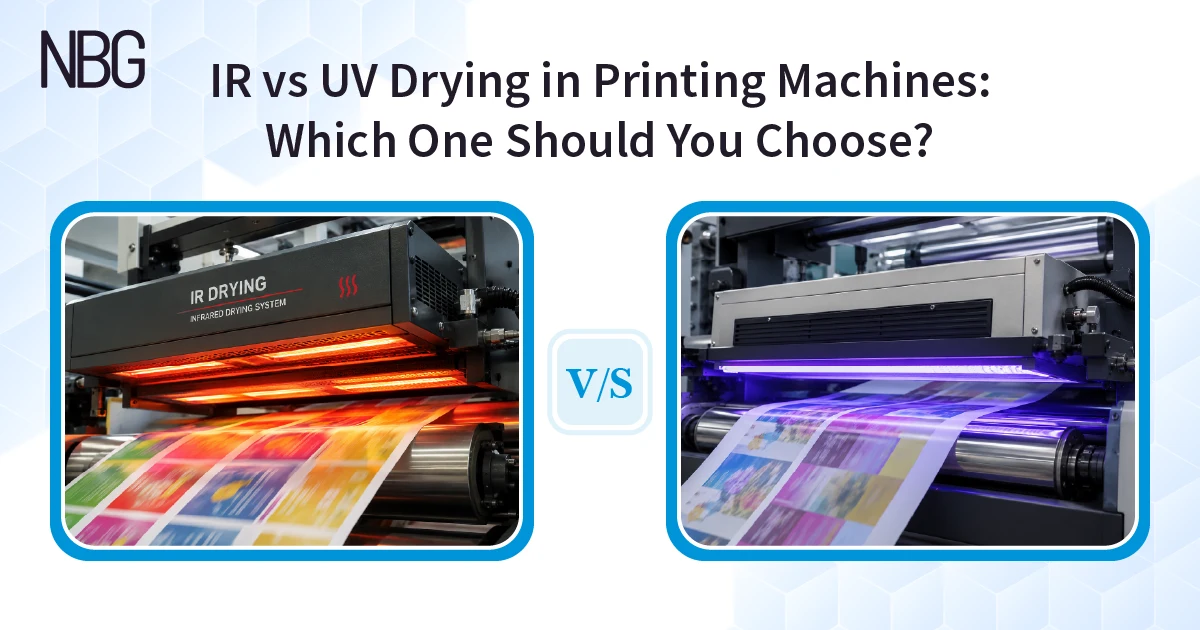
In the printing industry, drying is not merely a back-end operation; it is a factor that can impact production speed, print quality, and operational efficiency. From packaging to commercial printing to paper bag production, the drying system you select can have a big effect on your turnaround time and profitability. IR drying and UV curing are two of the most common drying technologies used in printing today. IR drying is a heat-driven process, and UV drying is an advanced process that delivers instant results. Understanding how these systems work and distinguishing between UV curing and IR drying is crucial to making an informed investment decision. This guide breaks down both systems to help you choose the best solution for your business.
A] What Is Conventional Drying in Printing?
Traditional drying processes involve exposing the ink to air and/or heat to allow the solvents to evaporate. Though easy and cheap, these methods are somewhat slow and may cause problems like smudging, uneven drying and increased production delays. With the growing need for print, the traditional drying method has been gradually replaced or complemented by alternative fast and improved drying methods such as IR drying and UV curing in high-volume industries.B] What Is IR Drying in Printing Machines?
IR drying systems use infrared radiation to generate heat, which the ink and the printing material absorb. This heat evaporates the ink solvents, causing the pigment to dry gradually.How IR Drying Works?
Infrared lamps generate heat energy, which goes through the surface of the print. With increased temperatures, the liquid portion of the ink begins to evaporate, forming a dry pigment layer. The drying speed will vary based on the type of material, heat intensity and exposure time. The key features of IR drying are as follows:- Commonly used for offset and flexographic printing.
- Can be used for solvent-based inks.
- Low cost and relatively easy to implement.
- Heat that can be adjusted for various substrates.
Upgrade to faster, high-quality printing with advanced drying technology.
C] What Is UV Drying?
A UV curing system uses high-intensity ultraviolet light to instantly cure inks and coatings through a rapid photochemical process. How Does UV Curing Work? When UV light hits the ink, it activates the photoinitiators. This triggers a chemical reaction that transforms the ink from a liquid to a solid instantly. The key features of UV drying are as follows:- No drying time - instant cure
- Clear, crisp and colourful prints.
- Appropriate for both absorbent and non-absorbent materials
- Eliminates risks of smudging or set-off
D] Difference Between UV and IR Drying
Choosing between UV curing and IR drying comes down to your production speed, substrate choices, and operational budget. Here is a direct feature comparison:| Feature | IR Drying Systems | UV Curing Systems |
| Operating Mechanism | Thermal evaporation via infrared heat | Photochemical polymerisation via UV light |
| Drying / Cure Speed | Moderate (requires heat absorption time) | Instantaneous (zero dwell time) |
| Compatible Inks | Water- and solvent-based inks | Specialised UV-curable inks |
| Substrate Versatility | Primarily absorbent materials (paper, board) | Porous and non-porous (plastic, film, foil, paper) |
| Print Quality & Finish | Standard gloss and clarity | Superior gloss, vivid contrast, and scratch resistance |
| Energy Efficiency | Higher energy draw (continuous heat generation) | Highly efficient (especially with modern UV LED lamps) |
| Post-Print Handling | Requires cooling/curing time before stack/finish | Immediate downstream processing and finishing |
E] Advantages of UV Curing Over IR Drying
In the printing industry, UV curing is becoming more and more popular:1. Instant Drying for Faster Production
The advantage of the UV curing system is that it eliminates drying time and allows continuous and high-speed printing.2. Superior Print Quality
It creates sharper images, richer colours, and a premium finish that elevates the overall value of the printed material.3. Energy Efficiency
UV LED systems use less energy than heat-based IR systems, directly lowering long-term operational costs.4. Eco-Friendly Process
UV curing emits very few volatile organic compounds (VOCs), which makes it more environmentally friendly.5. Versatility
UV systems easily adapt to diverse substrates, allowing print providers to handle everything from standard paper to heat-sensitive films and plastics. By transitioning from traditional thermal drying to modern ink curing methods, commercial printers can maximise operational efficiency, expand product capabilities, and achieve superior print performance.Related Reading: Types of Flexographic Inks and How to Select the Right One
F] Advantages of Sheeting Machines
The following are the key advantages of sheeting machines:1. High Precision and Accuracy
Whether for printing or packaging, sheeting machines maintain strict dimensional control over every sheet. Precise cutting minimises errors and improves overall product quality.2. Increased Productivity
Modern sheeting machines operate at high speeds to meet demanding production targets, minimising turnaround times and maximising output efficiency.3. Reduced Material Waste
Accurate cutting systems significantly reduce trim waste, helping businesses lower material costs and manage resources more effectively.4. Automation and Ease of Operation
Machine functions are easily managed through advanced PLC control systems. Automation minimises manual intervention and enhances operational reliability.5. Versatility
Sheeting machines accommodate a wide range of paper types, weights, and sizes, making them suitable for diverse converting applications.6. Improved Workflow Integration
These machines are designed to integrate seamlessly into existing printing and packaging lines, ensuring smooth production flow while minimising downtime.G] Choosing the Right Drying System for Your Business
There are many factors to consider when choosing the right drying technology:- Materials used: Paper bags, labels, packaging or commercial substrate materials.
- Production Volume: High-volume operations benefit more from UV curing.
- Cost: IR systems cost less up front; UV has higher ROI potential over time.
- Material Compatibility: UV can be used on a wider variety of substrates.
H] Advanced Printing Solutions by NBG Printographic Machinery
1. Product Offerings
- Top-quality systems from one of the country’s leading flexo printing machine manufacturers
- Custom offset printing machine solutions
- Efficient and ready-to-use paper bag manufacturing machine setup
2. Why Do Leading Brands Partner with NBG Printographic?
- Advanced drying technologies
- High-speed, automated machines
- Durable, low-maintenance designs
- Suitable for commercial-scale production
Conclusion
Although IR drying is a viable and cost-effective option, UV curing is superior for its speed, efficiency and print quality. As the industry trends towards faster and more sustainable processes, UV curing technology is increasingly preferred over traditional printing technology. As a trusted printing machine manufacturer, NBG Printographic provides cutting-edge solutions to meet the demands of today's printing requirements. Contact us now!FAQs
What materials can be used in a sheeting machine?Depending on machine configuration, cutting system and tension control capabilities, sheeting machines can process paper, kraft paper, coated paper, cardboard, paperboard, laminates, foil-laminated sheets, and some flexible packaging materials.
What are the main components of a sheeting machine?The main components consist of the unwinding unit, web guiding system, tension control system, cutting section (with blades), drive system, PLC control panel and delivery stacking unit (for organised sheet delivery).
What is the difference between rotary and cross-cut sheeting machines?Rotating sheeting machines are high-speed cutting machines and cross-cut machines are low-speed, high-accuracy cutting machines.
What is the speed of a paper sheeting machine?The velocity of a paper sheeting machine usually varies between 50 and 300 metres per minute, depending on the kind of sheeting machine, the thickness of the sheet, the degree of automation, and production needs.
What is the advantage of using a sheeting machine?The sheeting machines are crucial for modern paper converting and printing tasks as they provide high precision, faster production, waste reduction, automation, improved sheet quality and efficiency.