Key Components of a Paper Bag Manufacturing Machine Explained

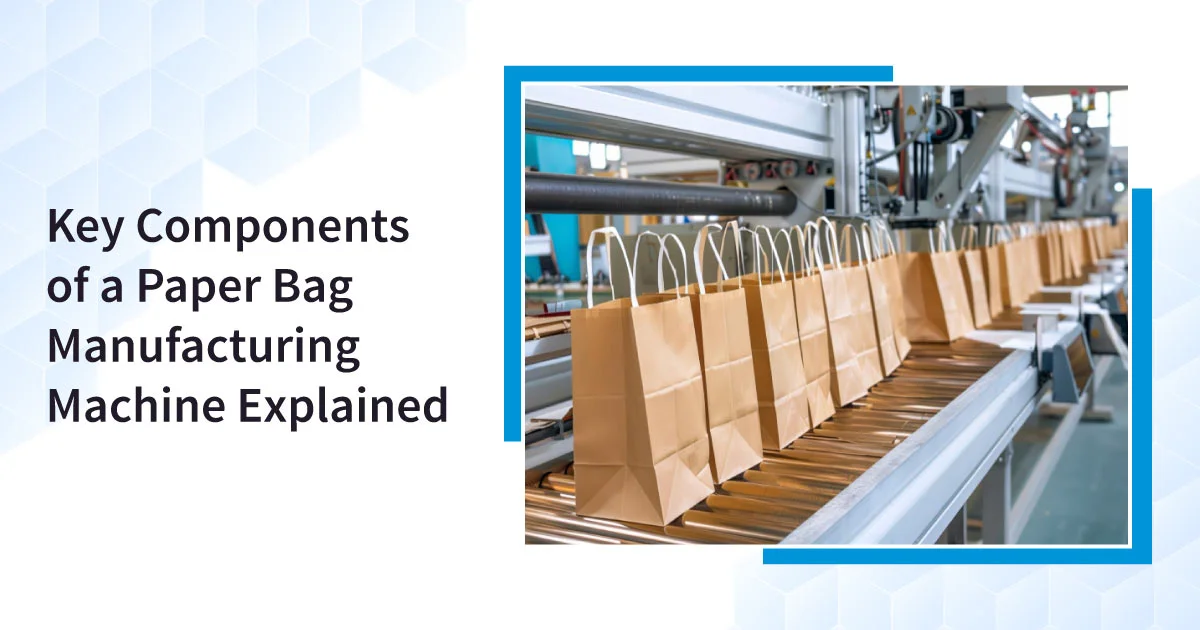
The paper bag manufacturing machines have already shown their significance by dominating the plastic-banned markets. The traits of the paper bag making machine, such as high efficiency, longer lifespan, and ease of use, allow businesses to make profits by selling paper bags in these growing markets. If you also want to venture into the paper bag-making business, this machine is for you; each part is engineered to fulfill the needs of businesses and drive profit for them. But what all are those parts, and what do they do in the paper bag machine? We will explore in this blog. Keep reading!
What Is a Paper Bag Manufacturing Machine?
A paper bag manufacturing machine is an automated manufacturing machine used to produce paper bags on a mass scale using rolls of specialised paper. It has mainly three types: flat-bottom, square-bottom, and V-bottom machines. These types are categorised based on the automation level and the types of bags they are designed to manufacture. These machines impeccably craft raw paper into finished bags through the streamlined step-by-step process. It involves printing, folding, gluing, and cutting. Due to unparalleled efficiency and accuracy, paper bag manufacturing machines have become indispensable for modern setups.Future-proof your paper bag manufacturing business with our automated paper bag machines.
Key Components of a Paper Bag Machine
The following are the key components of a paper bag manufacturing machine that play a key role in gaining production efficiency through mass producing paper bags with the highest accuracy:1. Paper Roll Feeding Unit
As the name suggests, the paper roll feeding unit is used to hold and unwind the large and wrapped paper rolls and finally feed them to the machine. This unit has several integrated parts, like a paper roll holder(unwinding rack), an automatic tension control system, and a web guide system for accurate paper alignment. These integrated parts of the paper roll feeding unit efficiently support the paper unwinding and feeding process and set the ground for producing paper bags on a mass scale.2. Tension Controller & Paper Alignment System
The tension controller and paper alignment system both work to tighten the unwound paper and ensure feeding process accuracy without any slack or breakage of fed paper throughout the process. The tension controller maintains consistent paper tension throughout the process. On the other hand, a paper alignment system, often controlled electronically, ensures proper positioning and alignment of paper moving through the machine.3. Printing Unit
The printing unit is integrated into the paper bag manufacturing machine to seamlessly print logos, texts, or visual designs onto the paper bags. The printing unit is separately installed depending on the user’s need or based on the requirement of the printing bags. The printing unit has separate components for ink application, image transfer, and ink drying.4. Side Glueing System
Side-gluing system sticks the paper bag by applying glue on every corner and seam, allowing the bag to be sealed from each seam position. It has integrated systems, like glue supply, application, and control. The glue supply streamlines the supply of glue through the reservoir that stores glue. Glue application involves precisely dispensing glue onto the paper and applying it consistently over the seam through a nozzle and roller.5. Tube Forming Section
The tube forming section of the paper bag manufacturing machine comprises a tube former, a side gluing system, and a cutting mechanism. These sections work in tandem to shape and prepare the paper for subsequent steps.6. Bottom Folding & Pasting Unit
The bottom folding and pasting unit is responsible for folding the bottom of the bag through various subsequent steps. They include folding paper, adhesive application, and pressing the folded section together to form a strong base. This process is crucial for ensuring that the prepared paper bag is strong and sealed properly.7. Cutting Mechanism
As the name suggests, the cutting mechanism takes care of paper-cutting requirements using the sharp blades. The mechanism is engineered to ensure the precise dimensions, including length and width. The cutting mechanism also allows customisation, which further permits the formation of desired-sized paper bags for bulk production.8. Bag Collecting Section
The bag collection section is dedicated to collecting the prepared paper bags and stacking them. The section uses an accumulator to count and stack finished bags made up of raw paper. It allows the paper bag manufacturing process to be more streamlined and helps improve efficiency by reducing manual collection and stacking work.9. Servo Motor/PLC Controls
The servo motor is responsible for providing efficient and controlled movement across the machine’s mechanical components used in paper bag machines. On the other hand, PLC (programmable logic controller) acts as a central brain for the machine, managing the overall processes. Both PLC control and servo motor work in conjunction to control the drive, flow, and speed of the paper bag manufacturing machine.How These Parts Work Together in the Bag-Making Process
The above-described parts of the paper bag manufacturing machine work together to make sturdy and high-quality paper bags. The paper roll feeding unit unwinds the paper roll; thereafter, the tube forming section tubes the paper, and the gluing system glues its edge. The bottom folding and pasting unit folds the bottom of the bag and presses it to give a strong base. Next, the cutting mechanism shapes the bag into the desired size, and the bag collection section collects and stocks the finished paper bags. This is how a papar bag machine works in a synchronised manner, coordinating with all parts to prepare a sturdy and appealing paper bag.
Also Read: Advantages of Paper Bag Machines
Maintenance Tips for Key Components
Every component of the paper bag manufacturing machine should be regularly lubricated. Each sensor of the machine should be periodically calibrated to ensure reliable and accurate measurement. In addition, cutting and gluing systems are more prone to dust and contamination, ensuring these systems are cleaned when needed makes the machine more efficient with a longer life span.Conclusion
We have explored the various components of the paper bag machine and how they work in tandem to skyrocket the paper bag manufacturing process. When choosing a paper bag machine, one should always ensure that the machine is equipped with quality parts.
In such a case, NBG Printographic Pvt. Ltd. is one of the top Paper bag machine manufacturers in India. Our machines are equipped with high-quality parts, allowing our clients to take the services of our machines for longer than they can think. We are also the leading printing machine supplier in India. We can effortlessly integrate a printing machine into the paperbag machine based on the client’s needs. Contact us today!
FAQs
What are the key components of a paper bag-making machine?The key components of a paper bag machine are the paper roll feeding unit, tension controller, paper alignment system, gluing system, tube forming section, bottom folding and pasting unit, cutting mechanism, and bag collection section.
What types of paper bag-making machines are available for businesses?The following are the types of paper bag making machines: automatic paper bag making machine with rope and flat handles series, semi-automatic sheet-fed square bottom paper bag machine, fully automatic sheet-fed square bottom paper bag machine, sharp bottom (V-bottom) paper bag machine, and roll-fed square bottom paper bag machine.
What are the maintenance requirements for core machine components?Lubrications, cleaning, and calibrations are the essential maintenance requirements that should be done to maintain and prolong the life of the core machine components.
What safety features are integrated within machine components?Various safety features are integrated into the paper bag manufacturing machine to protect operators from any accidents. It includes emergency stop buttons, safety guards and shields, and interlocks on the access doors.